Lucky: A Chronicle and a Calling
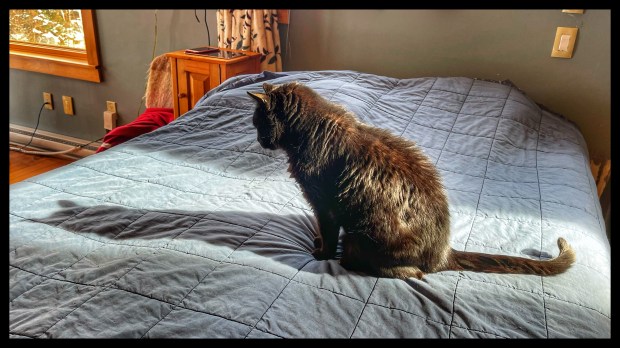
Our dear, first-found cat, Lucky, took his final breath as he lay silently between us in bed on the afternoon of Thursday, February 20.
Lucky was a singular cat who made a cat-lover out of me against all odds.
He came to our door on a stormy autumn night 19 years ago – a solitary, frightened kitten, hungry for love and shelter. He grew up to be a stoic and faithful companion who soon assumed an essential role in the care ecosystem of our household. He was our “nurse cat”, hyper-attentive to human moods and ailments, and always nearby, offering his signature patient vigil of steady, calming assurance.
Lucky’s decline was of unknown etiology. All of the standard veterinary indicators – blood work, x-rays, physical exam – were negative when we took him to the vet in late October. Like most cats, and like at least one of his human partners, he was quite aversive to the regimes of medicine, so we did not subject him to further veterinary visits or investigations as he continued to lose weight and as his world became smaller and smaller. In a telephone follow-up with his vet in late December, a possible diagnosis of feline lymphoma was suggested and steroids were prescribed. They seemed to boost his appetite a little, but the long-term dosing was never clear to me and in the absence of diagnostic probability, we were obliged to improvise our own palliative care plan for his final weeks of life.
There was never any doubt for Patricia or me that we would support Lucky to die a natural death in his own home. As he neared the end of his life, Patricia rose to every challenge of his ongoing care – providing soft, treat-spiked food whenever he showed any interest, pulverizing small doses of medication to mix with lickable treats, adjusting the height of his food and water dishes, breaking his treats into smaller pieces, placing bits of carpet around the floor to give him less slippery walking routes, placing a drawsheet outside his litter box when he could no longer climb in to enter, lifting him on and off of the bed whenever he signalled the desire to do so, and so on, as his mobility continued to decline. As we do routinely in response to my changing needs and capacities and those of disabled friends and visitors, we brainstormed, problem-solved and accommodated.
But accommodating a fragile feline presents its own unique challenges, not the least of which is the absence of networks of community expertise and support. At Lucky’s vet visit in October, there had been ominous murmurs evoking a calculation of “quality of life” that would lead, inexorably, to euthanasia. That, after all, is the “norm” for aging and ill household pets. My web searches for palliative feline care yielded little: one brief but thoughtful article, but no local resources or expertise. When I called the vet’s office on February 15, reporting that Lucky was on a clear trajectory toward death and losing mobility in his hindquarters, I requested a telephone consult. But a few hours later, the response came from the office that we should “bring him in” to see the doctor in “2 to 3 weeks”. We accepted the earliest appointment on offer, February 25, knowing that Lucky would likely be gone by then (he was) but that even if he survived until then, we would insist upon a telephone appointment instead.
Perhaps the vet was thinking that there was nothing she could do unless and until we came around to recognizing that euthanasia was our only option. I don’t know what was in her mind, but I had been told by the receptionist that there were appointments available on the very day that I had placed the call, so clearly this wasn’t considered to be an emergency. Quite possibly in this exchange, the vet believed that she was prioritizing Lucky’s needs over those of his family members. Or perhaps it was simply a communication breakdown: I had spoken at some length with the receptionist, who then spoke with the vet. The receptionist then called Patricia who reported the conversation to me. Lots of nuance can be lost in any of these gaps and translations.
Perhaps there was no fault at all here, just humans doing the best we could. But none of this operated to Lucky’s benefit. And this is precisely where I feel most acutely that a more holistic palliative approach was sorely missing. What could the vet have done for our family that she was not resourced or oriented or trained to do? She could have helped us prepare, helped us to know and to understand what to watch for and expect. Without this guidance, I was left to my own panicked interpretations and responses, a chemistry that would have only increased Lucky’s stress as death approached. Instead of frantic internet searches about why his eyes were fixed open, about whether he was producing tears or whether my own tears were obstructing my vision, about why no sound was coming from him as he opened his mouth in a clear howling gesture, perhaps a bit of prior knowledge or professional reassurance would have helped me remain more calm and present in his time of greatest need. In the weeks leading up to his death, perhaps knowing better what to expect in terms of a rapid loss of mobility would have enabled us to procure adaptive equipment on short-term loan or rental. A community that honours the possibility of home death for its non-human family members would come together with pooling of equipment and knowledge, better supporting each of us to do right by our cherished companions at the end of their lives.
Lucky had made clear his end-of-life wishes. Unambiguously, consistently and with simple clarity, he communicated each day that he wanted to be with us, nearby, included in the precious routines of our family life and participating to the extent that he could. He entrusted us to care for him through all that was to follow, and he accepted more and more of this care without any resistance that would signal a threat to his dignity. His final days were, I believe, as precious to him as they were to us. Was his a good death? I am convinced it was a better death than what our vet offered. But I am also convinced that it could have been so much better. At the very least, Lucky’s dying experience would have been better if I had been better able to fulfil my role as one of his people.
Lucky’s death leaves me bereft and mournful. More than this, and not surprisingly, given what a soulful, knowing creature he was, his death leaves me with questions. Like the restless, needy creature who appeared at my doorstep almost two decades ago, it is fitting perhaps that I now find myself unsettled, reaching for better, seeking with longing for a philosophy that more fully serves us all, human and nonhuman alike, through every storm of life.
Farewell, dear Lucky. Your life mattered. Your death too.

 The fragile and the wild